
12-31-25
By Lauren Royce, Editor
PENNSYLVANIA — Farmers spend a lot of time managing their equipment, their animals and their crops, but there’s one area they need to pay more attention to: their mental health.
Jeff Winton is the founder and chairman of Rural Minds, a nonprofit based in Mayville, NY that aims to combat the staggering rates of suicide and depression that plague the agricultural community nationwide. As a farmer himself, Winton knows that rural communities would rather hear advice from one of their own.
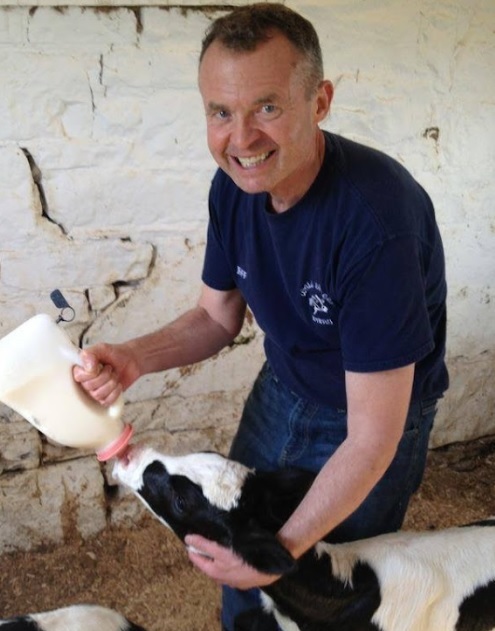
Jeff Winton and one of his calves on his dairy farm. Photo Provided
“Farmers in particular are three and a half times more likely to die by suicide than any other occupation, and people in general in rural America, whether they’re farmers or not, are 50% more likely to die by suicide,” Winton said. “But one of the most shocking statistics that’s just been released by the CDC (Centers for Disease Control), is that young people that grow up in rural areas– are now nearly 75% more likely to die by suicide than their peers that grow up in urban areas. Which is just tragic, that’s absolutely tragic.”
Winton founded Rural Minds in memory of his nephew Brooks, who lost his life to suicide at 28 years old. When Rural Minds Started four years ago, statistics for rural youth suicide rates were around the 50% range. But the COVID-19 pandemic exacerbated the issue, to the point where WInton has heard stories from school administrators of rural students attempting suicides during the school day.
“That’s why we’re doing a lot of work now focused on youth in rural America,” Winton said. “We’ve got a pilot program, in Pennsylvania and New York– working with youth organizations to address this.” The Rural Youth Mental Wellness Pilot Program on the Rural Minds website features a survey that can be filled out and guides on different topics such as bullying, domestic and sexual violence and depression among others.
According to statistics from the Central PA Food Bank and the 2022 Census of Agriculture, there were 49,053 farm operations in Pennsylvania as of 2022, operated by 90,032 producers. Of those producers, 740 were in Susquehanna County.
In a recent study by Rural Minds, a poll among 508 rural Pennsylvania residents found that seven out of 10 respondents said they were very concerned about depression in their community or struggling with it themselves.
“It’s important for other rural people, especially farmers, to know that they’re not alone,” Winton said. “That other farm families are suffering, other farm families have lost people in their families due to suicide.”
Winton has spoken in western New York, Nevada, even internationally about farmers’ mental health. Wherever he has gone, he said he has had people tell him their own stories of loss, often never spoken aloud due to shame. “Once people feel comfortable telling their story, the floodgates open,” he said. That connection then opens the door to people taking their first step toward getting help.
Winton said he has been to Harrisburg and spoken about the topic, and also spoke at a Pennsylvania grange meeting a couple of years back when he was invited by Pennsylvania Grange President Matthew Espenshade.
“I travel around the country to speak to groups and meet with farmers and other people in agriculture, and I’ve never seen people so concerned about what’s happening,” Winton said. “And a lot of it had been existing, but as I like to say, with some of the decisions that are being made in Washington now it’s really thrown gasoline on the burning fire and farmers are really hurting.”
Meaning economic pressure, just one of multiple stress factors facing rural people. For example, Winton said, since tariffs were implemented on China, China stopped buying American soybeans, putting the hurt on the soybean farmers in America. China started buying soybeans from Argentina, which received $20 billion from the United States to assist its struggling economy in October. Government bailouts aren’t a quick fix either, both because the amounts are not enough and because farmers are a proud people that prefer stable markets over handouts, Winton said.
“I was up in Montana two weeks ago, and I met with a thousand wheat and barley farmers up there. And they’re not only dealing with the aftermath of a record breaking drought, but due to the immigration reform they’ve lost a lot of their farm help. And of course the tariffs are having an impact on them, as they are on most of us in farming right now.”
Other real-world issues like not having a successor to their farms weigh on them as well.
“I’ve seen that across the country, farm succession is a huge issue,” Winton said. “We’re going through the very same thing on my dairy farm, I don’t have kids myself and nobody else, none of my nephews and nieces really wanted to take over the farm.” Now, his longtime farm manager is buying Winton’s farm in Chautauqua County, NY. In an area known for its resorts, farms are being bought left and right by people from cities, he said.
“There’s a lot of pressure on the current generation of any farm family to keep it going and to pass it on,” Winton said, “but if you don’t have anyone to pass it on, or you can’t afford to, which is becoming more and more the issue, then that’s a huge burden from a psychological and a mental health standpoint that a lot of farm families are carrying around. Especially a farm that’s been in the family for generations, you don’t want to think that you’re the end of that legacy. That’s a huge burden for people to carry.”
According to data from the CDC shared on the Rural Minds website, there are 20% fewer primary care providers than in urban areas. 65% of rural counties have no psychiatrist. Leading people to have to rely on a primary care provider who may not be fully equipped to deal with mental health issues.
“The fact remains we’ve got a shortage of healthcare providers in general across rural America but it’s especially acute with mental health providers,” Winton said. “There are no psychiatrists for example in Chautauqua County, you either have to go to Buffalo or Erie, Pennsylvania.” In any of the big western states, that drive could be three to four hours just to see a primary care physician, he said.
Because of this, Winton said, teletherapy visits have been instrumental in getting mental therapies to those that need them in a more accessible way.
“We’re hoping that these therapies will not only address that but will also address the stigma that exists because as you know, mental illness, despite the fact it’s called mental illness, still is not considered an illness in many parts of rural America.” It’s considered an embarrassment, something to just “get over.” But that’s not possible when people are living with cancer, PTSD, anxiety and other issues genuinely impacting their health.
“At a very basic level, a lot of our work over the last four years has been based in getting people in rural America to look at mental illness as a bonafide illness.” Not only that but getting them to understand that, but also that there is also oftentimes a genetic component, sometimes, too.
While the focus has been in farming and agriculture, the nonprofit looks at anyone and everyone in rural America: fishing industries, mining in Western Pennsylvania and Virginia, forestry workers, indigenous people and Amish people.
Oftentimes, stigma prevents people from even knowing where to go.
“In small towns, everybody knows your truck, and then the news starts traveling like wildfire,” Winton said. “I’ve had a lot of farmers tell me there’s a mental health clinic in my area but I don’t want to be seen there because (A), chances are I’m going to run into somebody I know because it’s the only clinic in town, and (B), even if I’m parked out front, all of a sudden people are going to start saying “Farmer Jones must be having some kind of an issue— we’re hoping that some of these digitals where people can utilize them in the privacy of their homes will help address that.”
Rural Minds has worked with Otsuka Precision Health, Inc., a health experience company dedicated to technology for mental and physical well-being. Still, another issue looms: 28% of rural homes still lack access to broadband Internet, further compounding the issue.
“Our goal is really storytelling and providing access to resources so while we’re not providing the digital therapies ourselves, we’re helping to communicate through conversations like this and through talks I give across the country the fact these resources are available and then we direct people to where they exist.”
Be the first to comment on "Rural Minds advocates for awareness of suicide, depression in rural communities"