
2-4-26
By Lauren Royce
HARRISBURG — The 2026 Pennsylvania State Farm Show hosted its equine events mostly as planned, after the November 2025 outbreak of Equine Herpesvirus Myeloencephalopathy (EHM) subsided.
“They were able to have the first frontier circuit, PRCA (Professional Rodeo Cowboys Association) finals rodeo,” said Capri Stiles, president of the Pennsylvania Equine Council (PEC) and biosecurity educator for Pennsylvania 4H. “Horses came from multiple states. I saw license plates as far away as Texas, and I even saw someone from Canada. So, um, that was, uh, really a great show. And the, um, PRCA put biosecurity measures in place, additional biosecurity measures.”
Stiles said the horses had to be accompanied by a log of their body temperatures that were taken twice a day for the 10 days prior to arrival. Once the horses were on the grounds, they had to stay on the grounds.
“The stalls were all completely cleaned and disinfected between the different events. So earlier, they did have to cancel the Junior Youth rodeo that typically takes place there. And that was initiated probably by the contestants,” Stiles said.
“The rodeo finals for PRCA were the top 10 contestants,” she said. “So you would have 10 horses there for each of the events. Whereas the Youth Rodeo, you could have had as many as 45 or even 75 horses in one of the rodeo events. A lot of differences that led to those different decisions. But they did replace the Youth Rodeo. They were able to secure contestants from the (National) Reined Cow Horse Association (NRCHA). They did some really, really neat events involving horses and cattle, so that was new and exciting.”
The outbreak, which originated at an international rodeo event held in Waco, Texas in November 2025, spread nationwide and into Canada, causing horse handlers to have to quarantine their farms.
According to the Equine Disease Communication Center (EDCC), only one horse in Northumberland County tested positive for EHM (the EHV-4 strain) unrelated to the Waco outbreak in November. One horse in Lancaster County was euthanized after testing positive for EHM and one other horse died.
“EHV-1 and EHV-4 most often cause a respiratory disease which is usually mild and self-limiting, and both can cause abortion,” reads the EDCC website. “EHV-1 and EHV-4 (very rare) can cause the neurologic form of the disease (equine herpesvirus myeloencephalopathy (EHM)) which creates damage to the spinal cord and can be fatal.”
While mares had to be kept home due to the disease’s potential to cause miscarriages in horses, the event was still good, Stiles said.
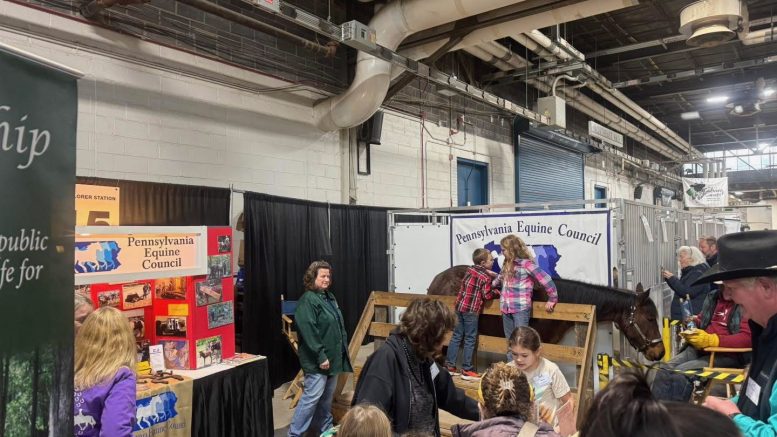
“It was a very exciting event. The Pennsylvania Equine Council had five horses on display there,” she said. “Our big, beautiful Friesian stallion that typically comes was not able to be there, because he is from a horse breeding facility and that was not a best management practice for him to be able to come. But we had two quarter horses and our mascot, Edward the Donkey, a spotted draft mare and an 18-year-old mini named Ranger.”
Stiles said the farm show saw record levels of attendance, with something like over 28,000 people who came to the show.
“The Pennsylvania Equine Council is staying in contact with the Pennsylvania Department of Agriculture and we keep watching for updates, and so far so good,” Stiles said. “Unless there’s an additional outbreak or something, some new disease on the horizon, I think we’ll be right back to business.” The quarantine order will have lapsed by next year, as it’s through February 28.
The complex is used for multiple horse events throughout the year. There will be the horse World Expo on March 5, which the PEC will be there for.
“We’ve had a lot of people that have been traveling across state lines, and there have been some improvements or updates made to the certified veterinary inspections,” Stiles said. “All of those things that the states have put in place will help mitigate the disease and hopefully keep it from getting worse and spreading to other horses.
“I have been impressed with how seriously horse owners have taken this. There were a few naysayers in the beginning and they didn’t understand or weren’t absorbing, because out of 233,000 horses in Pennsylvania, how many were actually infected? Well, if you look at it percentage wise, it’s very, very small. But it stayed small because people took it seriously and, and the disease mitigation was, uh, was positive.”
With spring on the way, there are other diseases and issues to watch for, such as shipping fever and strangles, which are common stress related issues in racing horses.
“We just hope for a successful season for everybody, and don’t be afraid to get out and enjoy your horses, but be smart about it,” Stiles said. “Build awareness and make small changes that will help you in the end. I think one of the things you might see people doing if they have the facility is they might install some sort of a run-in shed with a single stall, as far away from the rest of the horses as possible. In case they would have to quarantine one.”
Be the first to comment on "Farm Show recap: EHM aftermath"